

Prize Calculation
TournaChess can calculate prize distribution for your tournament sections following USCF rules. If you run rated tournaments with cash prizes, this feature handles the math for you -- splitting tied prizes, enforcing eligibility rules, and producing a clear breakdown that you can use to pay out winners.
This feature is designed for Tournament Directors running USCF-rated events. It supports the most common prize structures used in over-the-board tournaments.
Prize Types
TournaChess supports six types of prizes. You can mix and match them within a section to build the prize structure your tournament needs.
Place prizes
Place prizes are awarded by final standing position. First place goes to the player who finishes first, second place to the player who finishes second, and so on. Every player in the section is eligible for place prizes regardless of rating.
Class prizes
Class prizes are restricted to players within a specific USCF rating class. Only players whose pre-tournament rating falls within the class boundaries can win that prize. The standard USCF rating classes are:
| Class | Rating Range |
|---|---|
| Master | 2200 and above |
| Expert | 2000 -- 2199 |
| Class A | 1800 -- 1999 |
| Class B | 1600 -- 1799 |
| Class C | 1400 -- 1599 |
| Class D | 1200 -- 1399 |
| Class E | Under 1200 |
A player rated 1800 is Class A (the boundary belongs to the higher class). A player rated 1799 is Class B.
Under prizes
Under prizes are open to all players rated below a specified threshold. For example, an "Under 1800" prize is available to any player with a pre-tournament rating strictly less than 1800. A player rated exactly 1800 is not eligible for an Under 1800 prize.
Biggest upset prizes
A biggest upset prize goes to the player who beat the highest-rated opponent relative to their own rating. Every decisive game in the section is measured by the gap between the two players' ratings, and the largest gap wins.
Unlike the other three types, this prize is not tied to where anyone finished. It does not use up a place, and it takes no part in tie splitting between finishers -- it is awarded separately, after the place, class, and under prizes are settled.
It is also one of the three prizes you can offer across the whole tournament rather than inside a single section. See Tournament-wide prizes below.
Two settings are available when you add one:
- Min gap -- the smallest rating difference that qualifies, for flyers that advertise something like "biggest upset, 200+ points". Leave it blank and any win over a higher-rated opponent counts.
- Only award to players not otherwise receiving a prize -- when checked, the prize skips any player who already won a place, class, or under prize in the section and goes to the next-biggest upset instead. Leave it unchecked (the default) and the upset prize is paid on top of whatever else that player won. The same option is available on any $0 prize, for the same reason.
You can offer more than one, for example a first and second biggest upset. Each goes to a different player, and each player is measured on their single biggest upset -- winning two big games does not win two upset prizes.
Best female performance prizes
A Best Female Performance prize goes to the highest-scoring female entrant, judged on the Gender registration field. Score is the whole criterion -- there is no rating-relative adjustment.
Eligibility follows where you define the prize. Configure it for a section and every player in that section is in the running; configure it for the tournament and every player in the event is. Nothing else narrows it -- not the section's Gender field setting, and not the entry type a player chose. Defining the prize is the decision.
You do not have to turn the Gender field on to award it. The field decides whether players answer for themselves; where they have not, eligibility falls back to the rating bodies as below. Turning it on is still worth doing when you want players' own answers rather than a federation's record of them.
Who counts as eligible. The player's own answer decides it wherever they gave one: someone who answered Female is eligible, and someone who answered Male is not, even if a federation's records say otherwise. Where the player left the field blank or was never asked, eligibility falls back to the rating bodies -- US Chess's member record first, then FIDE's -- exactly as the registration details show it, so what you see on a registration and what the prize awards on are always the same thing.
Two cases are deliberately never awarded:
- A player who chose Prefer not to answer is left alone. Declining is an answer, and falling back to a federation record would award the prize on precisely the disclosure they withheld.
- A federation value that is neither a clear male nor a clear female record counts as nothing, rather than being guessed at.
If nothing in any of those sources says female, the prize is left unawarded rather than guessed at.
Like a biggest upset prize, this one is not tied to a finishing position. It uses up no place, joins no tie split between finishers, and is awarded after the place, class, and under prizes are settled -- so by default it is paid on top of anything that player already won. Check Only award to players not otherwise receiving a prize to have it skip a player who won something else in the section and pass to the next-highest-scoring female entrant instead.
Unrated players are eligible by default, because score is something an unrated player has. Untick Unrated eligible if your prize structure says otherwise.
You can offer more than one -- a first and second Best Female Performance -- and each goes to a different player, in score order. It can also be offered across the whole tournament; see Tournament-wide prizes.
Ties are settled the same way every prize in TournaChess settles them: cash is split between everyone on the top score, while a Trophy cannot be split and is decided by the section's tiebreaks, falling back to rating when the tiebreaks run out. A tournament-wide one is settled the same way when the sections involved agree on their tiebreaks; see Tournament-wide prizes.
Best debut prizes
A Best Debut prize goes to the highest-scoring unrated player. Score is the whole criterion, exactly as it is for a Best Female Performance -- the prize simply asks a different question about who is in the running.
Unrated means unrated in this event. A player is eligible when the section has no rating on file for them from any federation it is rated by: the US Chess rating in a USCF-rated section, the FIDE rating in a FIDE-rated one, the NWSRS rating in an NWSRS section. A section rated by two federations checks both — a player holding a US Chess rating but no NWSRS one is an established player there, whichever of the two the section pairs on, so they are not making a debut. A rating of 0 counts as unrated, since that is how an unrated player is often typed in.
Note that this is not the rating a class or under prize bands on, which is the US Chess one everywhere but an Online section. The two can disagree about the same player, and deliberately do: an incidental US Chess rating should not put someone in a class band's way of a FIDE section's debut prize, nor keep them out of it. The Prizes tab and the printed payout sheet show the rating the section was judged on, so the number beside a Best Debut winner is the one that made them eligible.
Which sections can offer it. Best Debut is the one prize you can configure on a section that US Chess does not rate: it needs a rating for its winners to have arrived without, and FIDE and NWSRS each supply one just as US Chess does. Every other prize type still requires a USCF-rated section, so on a FIDE-only or NWSRS section the Prizes tab offers Best Debut and nothing else.
Two kinds of section cannot offer it:
- Online-rated sections. An online rating is a site's record of blitz games, not a federation's record of tournament play -- so "no online rating" is at least as likely to mean the player never linked an account as that they are new to chess. Awarding a debut prize on it would name a winner the phrase does not describe.
- Unrated sections. Every player in one is unrated, so the prize would be the section's first place under another name.
The consequence worth knowing before you advertise the prize: a rating you type in makes a player rated. If a first-time player turns up and you enter an estimate so they can be paired sensibly, they are no longer eligible for Best Debut. If you want them in the running, leave the rating blank and let the pairing handle them as unrated.
There is no Unrated eligible setting on this prize. Being unrated is what makes a player eligible, so the option would only ever describe a prize nobody could win.
Like a biggest upset prize, this one is not tied to a finishing position. It uses up no place, joins no tie split between finishers, and is awarded after the place, class, and under prizes are settled -- so by default it is paid on top of anything that player already won. Check Only award to players not otherwise receiving a prize to have it skip a player who won something else in the section and pass to the next-highest-scoring unrated player instead.
You can offer more than one -- a first and second Best Debut -- and each goes to a different player, in score order. It can also be offered across the whole tournament; see Tournament-wide prizes.
Ties are settled the same way a Best Female Performance settles them: cash is split between everyone on the top score, while a Trophy cannot be split and is decided by the section's tiebreaks. Rating is the usual last resort when the tiebreaks run out, and it decides nothing here -- every contender is unrated -- so configure tiebreaks on the section if you are offering this as a trophy.
Class vs. Under -- what's the difference?
A class prize targets a single rating band. A "Class B" prize can only be won by a player rated 1600--1799. A player rated 1500 cannot win a Class B prize -- they are Class C.
An under prize targets everyone below a threshold. An "Under 1800" prize is available to players rated 1799 and below, including Class B, Class C, Class D, and Class E players. Under prizes cast a wider net.
Most tournament prize structures use one approach or the other. Some use both -- for example, place prizes plus an "Under 1800" prize and a separate "Class E" prize.
How Ties Are Handled
When multiple players tie for positions that span one or more prizes, TournaChess pools the prize money and splits it equally among the tied players. This follows USCF Rule 32B (pool sharing).
Example: two players tied for 1st/2nd
Your section offers $200 for 1st and $100 for 2nd. Two players finish with the same score at the top. The 1st and 2nd place prizes are pooled: $200 + $100 = $300, split two ways. Each player receives $150.
Example: three players tied for 3rd
Your section offers $75 for 3rd place. Three players are tied for 3rd. The $75 prize is split three ways. Each player receives $25.
Rounding
When a prize amount does not divide evenly, TournaChess rounds up so that every player in the split receives the same amount. For example, $100 split three ways pays $33.34 to each player. This may result in the total paid exceeding the original prize fund by a few cents.
Separation
In some situations, a subset of tied players is eligible for a restricted prize (class or under) that would pay them more per person than the pooled share. USCF rules require that this prize be separated from the pool and distributed only to the eligible subset, while the remaining pool is shared among the rest of the group. TournaChess handles this automatically.
Tip: You do not need to think about separation logic yourself. Configure your prizes, and the calculator applies the correct USCF rules.
Eligibility Rules
The calculator applies the following rules to determine who can win each prize:
- Pre-tournament rating determines eligibility. The rating a player had before the tournament started is used for all class and under prize calculations, not their performance during the event.
- Unrated players are eligible for place prizes, for Best Female Performance, and only they are eligible for Best Debut. Players without an established USCF rating cannot win class or under prizes, and cannot win a biggest upset prize -- neither can a win over an unrated opponent, since there is no rating gap to measure. The two score-decided prizes are the exceptions: score is something an unrated player has, so they are eligible for Best Female Performance by default (untick Unrated eligible on that prize if your prize structure says otherwise), and Best Debut is open to nobody else. Note that class and under bands read the US Chess rating even in a FIDE or NWSRS section, while Best Debut reads the federations that section is rated by -- so the two can disagree about the same player, and deliberately do.
- Only games actually played count as upsets. A forfeit win, a bye, or a draw against a much higher-rated player does not qualify. The winner must also still be in the tournament at the end, like any other prize winner.
- Tied upsets split the prize. If two players overcame exactly the same rating gap, they share the upset prize equally, the same way tied finishers share a place prize.
- Withdrawn players are ineligible. Players who withdrew from the tournament before it ended do not receive any prizes.
- Boundary ratings belong to the higher class. A player rated exactly 1800 is Class A, not Class B. A player rated exactly 2000 is Expert, not Class A.
- Under thresholds are strict less-than. A player rated exactly 1800 is not eligible for an Under 1800 prize. Only players rated 1799 and below qualify.
How to Use
Configuring prizes
- Open your tournament's management page and navigate to the section you want to configure.
- Click the Prizes tab in the section settings.
- Add prizes by specifying the type (Place, Class, Under, Biggest Upset, Best Female Performance, or Best Debut), the amount or the Trophy box, and any type-specific details (place number, class code, rating threshold, or minimum rating gap).
- Add as many prizes as your tournament structure requires. They are processed in the order you define them.
Your changes save on their own a moment after you stop typing -- there is no separate save step for prizes.
Tournament-wide prizes
Most prizes belong to a section, because that is where a finishing position means something -- there is no way to rank a 4/5 in the Open against a 4/5 in the Reserve when the two fields never played each other. Three prizes do not need a ranking, and can be offered across the whole event: Biggest Upset, which is measured inside a single game, and Best Female Performance and Best Debut, each of which names the best score among a handful of players rather than ordering the field.
To add one, open Tournament Settings and click the Prizes tab. From the Prizes tab of a running tournament, Actions → Tournament Settings opens on that tab directly.
A tournament-wide Biggest Upset is decided over every USCF-rated section at once -- the largest rating gap anywhere in the event wins it, whichever section the game was played in. The gap is measured between USCF ratings, so sections rated another way (FIDE-only, NWSRS-only) or not rated at all contribute no candidates, and a tournament with no USCF-rated section cannot offer the prize. Everything else about it works the way the section version does: both players must be rated, only games actually played count, ties split it, and you can set a minimum gap or offer a second and third.
A tournament-wide Best Female Performance is decided over every section, whatever its rating type: score is something every section has, so a FIDE-only or unrated event can offer this prize even though it cannot offer a tournament-wide Biggest Upset. No section has to be collecting the Gender field: eligibility follows where you defined the prize, so every registration in the event is in the running on whatever gender can be determined for them -- see Best female performance prizes above. One thing to weigh before you offer it: if your sections play different numbers of rounds, comparing raw scores across them favours the longer schedule.
A tournament-wide Best Debut is decided over every section rated by US Chess, FIDE or NWSRS, and carries the same caution about sections that play different numbers of rounds. Each section's players are judged against that section's own federations, so an established FIDE player in a FIDE-rated section is not swept in as a debutant because they happen to carry no US Chess rating. Online-rated and unrated sections contribute no candidates, for the reasons given under Best debut prizes above, and an event made up entirely of those cannot offer the prize.
Any tournament-wide prize can be a Trophy, on the same terms as a section one. The difference is how a tie is settled, and it depends on the prize.
A Biggest Upset trophy tied on the rating gap falls to the higher score across the event, and then to rating: there is no shared field to compare, so section tiebreaks cannot separate two players who never faced the same opponents.
A Best Female Performance or Best Debut trophy tied on score uses the sections' tiebreaks -- but only when every section holding a player in that tie is configured with the same tiebreaks in the same order. Each player's values are still computed inside her own section, as they always are; what the matching configuration establishes is that the event asked for the same measure everywhere, so the trophy follows the order both players' standings tables are already ranked by. If those sections break ties differently, or any of them has no tiebreaks configured, there is no shared answer to apply and the tie falls to rating instead.
Only the sections actually contesting the award are consulted -- the ones holding a player who can still win it. How the Open breaks its own ties does not matter if the tied players are all in the Reserve; neither does a section holding a contender who finished below them, nor one holding a player this particular prize rules out, such as an unrated player on a Best Female Performance with Unrated eligible unticked, someone skipped by "only award to players not receiving a prize in their section", or the winner of the prize above this one. None of them is in the running, so none of their sections has a say in separating the players who are.
A Custom tiebreak counts as shared only when the sections also give it the same name. It is whatever you decided it is, entered by hand per section, so one section's "Blitz Playoff" and another's "Coin Flip" are two unrelated numbers however similar the setting looks; where the names differ, the tie falls to rating.
Two things are worth knowing about how these interact with section prizes:
- They are paid on top by default. A player can win their section's first place, their section's Biggest Upset, and the tournament's Biggest Upset, and receive all three. Check Only award to players not receiving a prize in their section to change that: the tournament prize then skips any player who already won something in their own section and passes to the next candidate in the event. "Already won" means inside their own section -- a player who took nothing where they played is eligible however much the other sections paid out.
- They are paid from their own table, not from the winner's section. The Prizes tab shows a Tournament-wide prizes card at the top listing each award, the section its winner came from, and the same payment status, Amount paid and notes fields the section tables carry. That is where you settle them. The winner's section table lists only what that section awarded, so a player who won both their section's first place and the event's biggest upset appears on both sheets, with the two payments tracked separately -- marking one paid says nothing about the other. The printed sheet is laid out the same way.
Trophies
Tick Trophy on any prize -- place, class, under, Biggest Upset, Best Female Performance, or Best Debut -- to make it a physical award rather than a share of the prize fund. A trophy carries no cash -- the two are exclusive -- and it names a winner on the Prizes tab and the printed payout sheet like any other prize.
Trophies behave differently from cash in the ways that matter for handing out an object:
- They are never split. Cash pools and divides between tied players; a trophy cannot. The section's tiebreaks decide who takes it. This is what the Trophy box does that a $0 amount alone does not — on a Biggest Upset, ticking it is the only thing that makes the award indivisible.
- They are awarded separately. Cash is divided first, then the trophies. Adding a trophy never changes who gets paid what.
- A place trophy outranks a class or under trophy. If the section winner is also the top Class B player, they take the 1st Place trophy and the Class B trophy passes to the next Class B player. One player, one trophy.
- Class and under trophies rank within their own band. "1st Class B" goes to the best-placed Class B player, "2nd Class B" to the next one down.
- An upset trophy goes to one player. A cash Biggest Upset splits between players who overcame the same rating gap; a trophy cannot, so the one higher in the standings takes it and the other stays in line for a 2nd Biggest Upset trophy if you have configured one. Everything else about the prize is unchanged: it is still decided on rating gap, still paid on top of anything else that player won, and still respects a minimum gap.
- A Best Female Performance trophy goes to one player. Same rule, one criterion over: a cash prize splits between everyone on the top score, and a trophy goes to whichever of them the section's tiebreaks put higher (rating, when the tiebreaks run out).
- A Best Debut trophy goes to one player too, decided the same way -- with the difference that the rating fallback settles nothing here, since every contender is unrated. Configure tiebreaks on the section if you are offering one.
Turn tiebreaks on before relying on trophies. Because a trophy is never split, a tie has to be broken. With tiebreaks configured, the trophy follows the standings order your players can see. Without them, ties fall back to seeding -- an order, but not one based on how anyone played. The prize editor shows this reminder whenever a trophy is configured.
A player can still hold a trophy and cash at once -- the section winner taking the 1st Place trophy and the Class B money, say. If you would rather spread the recognition around, check Only award to players not otherwise receiving a prize on the trophy. A class or under trophy then passes to the next eligible player who has not already won; a place trophy is simply not awarded, since "1st Place" names a position and the runner-up did not finish first.
A place, class or under prize left at $0 without the Trophy box ticked is treated the same way -- it has no cash to pool, so it is awarded alongside the trophies rather than inside the prize fund, tiebreaks and all.
Biggest Upset, Best Female Performance and Best Debut left at $0 are the exception, and it is worth knowing before you rely on it. Ticking Trophy is what makes one of these indivisible; leaving it at $0 without ticking it keeps the cash rules, so two players who tie for it both get named as winners of that one prize rather than one of them being chosen. Tick Trophy when you mean a single object going to a single player.
On the Prizes tab and the printed sheet, a trophy is labelled as one: "1st Place (trophy)", "Biggest Upset (R3, def. 2010, +560; trophy)", "Best Female Performance (4.5; trophy)", or "Best Debut (4.5; trophy)". That keeps it clear when a section offers both a paid prize and a trophy of the same kind, and the same player takes both.
A $0 award counts as a prize everywhere a paid one does. An upset prize set to Only award to players not otherwise receiving a prize skips a player who won a $0 place or class prize, exactly as it would for a cash prize -- what matters is that they already won something, not what it was worth.
Viewing prize distribution
Prizes appear on the Prizes tab of the tournament management page. The tab is visible only to Tournament Directors, Admins, and Owners, and it only shows up once the tournament has at least one prize configured -- in a section's settings, or in Tournament Settings for a tournament-wide one.
There is no Calculate button -- prize amounts update on their own as results are entered, including results entered by another TD on a different device. They also update after the other changes that affect who wins what, such as moving a player to a different section, merging one section into another, a rating changing (whether you correct it yourself or the nightly US Chess refresh does), withdrawing a player from the final round, editing a custom tiebreak value that decides who takes a trophy, or rolling a section back to an earlier round. While the tournament is still active, prizes are labeled projected, because a later result can still change them. Once you mark the tournament complete, they are labeled final -- and a Prizes tab that is already open switches over on its own, without a refresh, even when another TD is the one who marks it complete. Final prizes are called ready to pay out only when no unfinished game is found that could change an award; if one is, the tab says so and flags the winners it could affect (see Games that could still change a prize below). A board that pays the same however it ends does not count against readiness. A section's readiness covers the prizes that section awarded: a board elsewhere in the event cannot change them, so it is not counted here. A tournament-wide prize is settled across every section at once, so its own card is labelled separately -- and unfinished boards elsewhere in the event count against it, since a result in another section can take that award away. Which boards depends on the prize. A Biggest Upset is measured between two USCF ratings, so only the event's USCF-rated sections are swept; sections rated another way are left out, because nothing played there can win it. A Best Female Performance is decided on score, which every section has, so rating type does not restrict it; a Best Debut adds one restriction, since only US Chess-, FIDE- and NWSRS-rated sections can produce a debutant. Beyond that, only sections holding an eligible entrant can produce a winner for either, so only those sections' boards count. Within those sections it narrows again to the boards an eligible entrant is sitting at, with two exceptions that widen it back to every board there: a prize set to skip players who already won in their own section, because any result can change which section prizes they won, and a Trophy, because the tiebreaks that settle a tie for one are computed from how a player's opponents finish.
Each award shows the player's award amount and a description of how it was determined (for example, "1st/2nd Place split 2 ways" or "Class B"). An upset award names the game that won it -- "Biggest Upset (R3, def. 2010, +560)" means a round 3 win over a 2010-rated opponent, 560 points above the winner. A Best Female Performance or Best Debut award names the score that won it -- "Best Female Performance (4.5)", "Best Debut (3.5)". A player who wins any of them alongside a place or class prize shows both, and the amount is the total.
Prize distribution never appears on the public tournament page or to players. You are responsible for communicating prize amounts to your players and handling payouts.
Games that could still change a prize
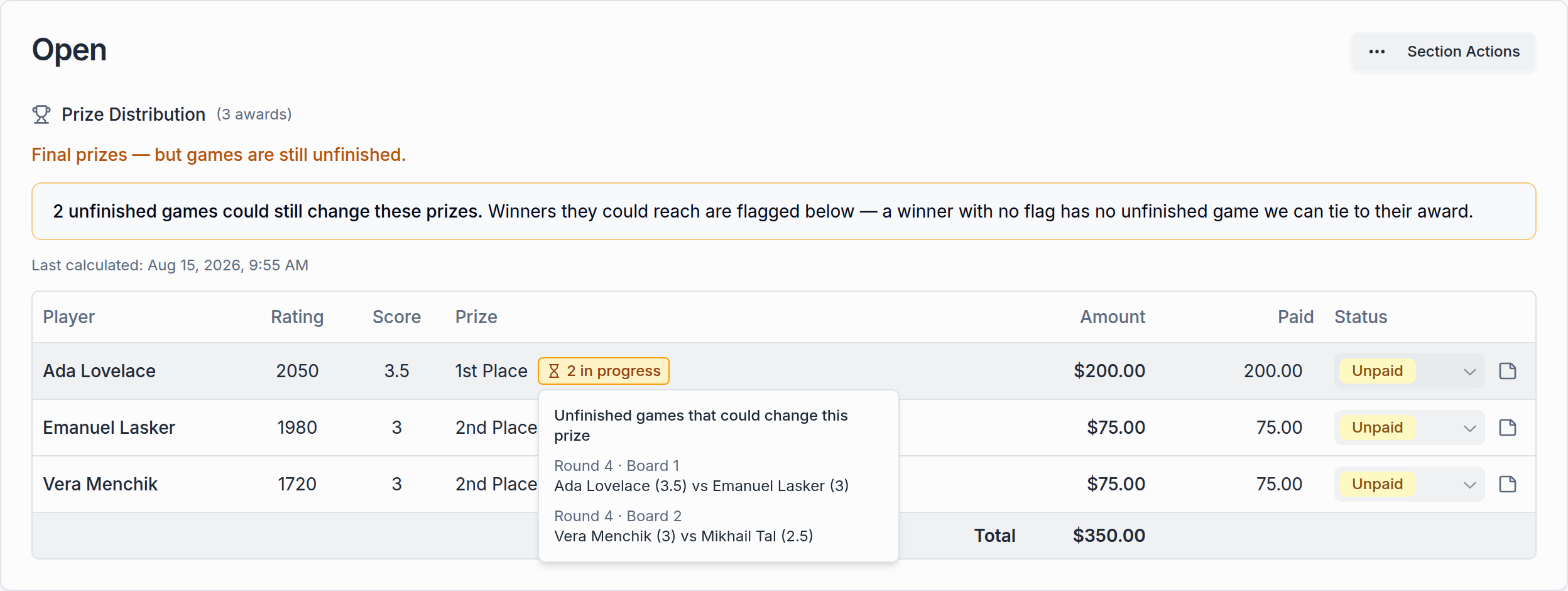
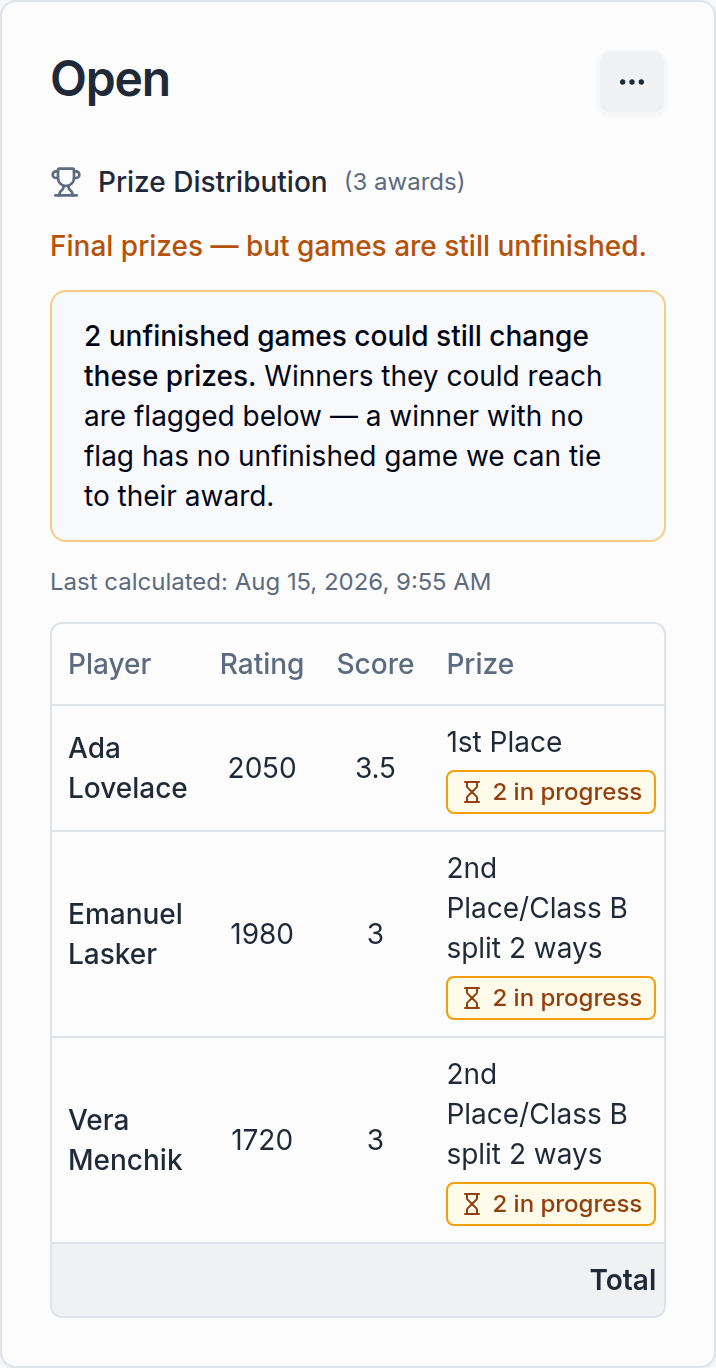
Marking a tournament complete does not mean every board is finished, so the Prizes tab also tells you what is still outstanding. When a game in the section has no result entered yet, a banner above the table says how many such games could still change the prizes, and each winner those games could reach gets an in progress flag next to their prize. Click the flag to see the games behind it -- round, board, and both players with their current scores.
The same flags are available on a phone, so you can check a winner while you are standing at the prize table.
A game is listed by playing it out every way it can end -- white wins, black wins, draw, a double forfeit scoring nothing for either player, and the custom scores in between that would leave a player level with somebody else -- and recalculating the whole section's prizes for each. If those results do not all come out the same, the game is listed, and it is flagged against every winner whose prize changes between them. What counts as a change is who wins which prize and who they share it with, rather than the dollar figure, so a result that swaps the winners of two equally sized prizes is flagged just like one that moves money. That is a stronger check than comparing scores or rating classes, because prizes interact: a player who cannot win a given class prize can still change it by tying the player who holds it, since a tie pools prizes and splits them. Players who have withdrawn are left out, since they win nothing whatever they score, and a game that pays the same however it ends -- a last board two points off the money -- is not listed at all.
There is a limit worth knowing. Each unfinished game is checked on its own, and against the case where the other outstanding boards go to the players still on them. TournaChess does not try every combination of every unfinished result, so a payout that only moves when several specific games all fall a specific way may not be flagged.
A section offering a trophy of any kind, Biggest Upset included, is treated differently, and deliberately more cautiously: every unfinished game is listed, without a winner named against it. A trophy is never split, so a tie for one is settled on the section's tiebreaks -- and most tiebreaks depend on how a player's opponents finish, which means a board neither contender is sitting at can still decide which of them takes it. Rather than work through that while you wait, TournaChess says the same thing about every outstanding board: check it by hand. Once the last result is in, the flags clear and the trophies are settled.
In the other direction, a section can be complicated enough that TournaChess cannot settle whether a game matters -- a very large field with a very long prize list, a large tie where many players are eligible for the same list of overlapping under-rating prizes, scores spread so finely that a game has too many possible results to work through while you wait, or simply too many games still out at once in a large tied field to work through all of them. In that last case the games checked before time ran out are answered normally, and the rest are the ones left open. Rather than guess, it lists those games anyway and says they need checking by hand, without naming a winner against them.
Games can appear in that same list for two other reasons, and each one says which applies to it. A game can be one TournaChess could not match to a player at all -- that points at a data problem rather than an unanswered question. Or it can be a game whose only effect is to put somebody on the prize list who is not on it yet: there is no winner's row to flag it against, because the row does not exist until the game is played.
Just after a result is entered, the tab says prizes are still updating rather than ready to pay out: the recalculation runs a moment behind the result, and until it lands the amounts on screen are the previous answer. The other changes that move prizes -- correcting a rating, withdrawing a player, moving someone between sections, editing the prize list -- recalculate the same way but are not called out like that, so give the tab a few seconds to catch up after one of those before treating the amounts as final.
That is exactly why TournaChess stops at listing games rather than telling you a prize is safe to pay. A winner with no flag has no unfinished game that TournaChess can tie to their award, and the call is yours to make from that.
Printing prizes
The Print button in the Prizes tab header produces a printer-friendly payout sheet for everything currently shown -- the sections on screen and any tournament-wide awards -- listing each winner's name, rating, score, prize, award amount, amount paid, and payment status, with a per-section total. Every card on the tab can also be printed on its own: use the Section Actions menu on a section's card for that section alone, or the Event Actions menu on the Tournament-wide prizes card for the event's awards without any section. Like the rest of the tab, the sheet is Tournament Director--only and never reaches players.
Winners are listed by award amount, largest first. Awards worth the same -- most obviously a section of trophies, where every award is $0 -- are listed in prize order instead: 1st Place before 2nd, place prizes before class prizes, and the prizes settled outside the pool (Biggest Upset, Best Female Performance, Best Debut) last.
If the event has a tournament-wide prize, the sheet opens with a Tournament-wide prizes table naming each winner, the section they came from, and what has been paid -- matching the card on the Prizes tab. Those awards are not repeated in the section tables below, which list only what each section awarded.
Printing a single section is the one case that narrows that table rather than dropping it: the section's sheet carries a tournament-wide award only if that section's player won it. Printing each section in turn therefore hands out every award exactly once, with no payout desk holding a duplicate.
Recording payouts
Each player's row has a payment status -- Unpaid, Paid, or Follow Up -- and an Amount paid field. The amount defaults to the calculated prize; change it when you pay out something different, for example deducting an entry fee for a free titled-player entry. A notes field is also available for payment details such as a Venmo handle or mailing address.
When you mark a player Paid, TournaChess records the amount showing at that moment as the amount paid. If a later result changes that player's calculated prize, the Amount paid figure stays at what you actually handed over rather than following the new prize. You can still correct it by editing the field. Marking a player Follow Up records no amount, since the money has not changed hands yet.
If you move a player back to Unpaid or Follow Up after marking them Paid, the recorded amount is cleared -- it described a payment that is no longer being made. The Amount paid field goes back to tracking the calculated prize, so if you mark the player Paid again later, what gets recorded is the prize as it stands then. An amount you typed on a row that was never marked Paid is left alone.
Payment status, amount paid, and notes stay with the player if you move them to a different section: the record follows them, so someone already marked Paid does not reappear as unpaid in their new section. If the same player has payout details recorded in both sections, the two are combined, keeping Paid over Follow Up over Unpaid.
Handing over a prize means making sure you have the right player in front of you. The eyeball beside each winner's name opens their registration details -- USCF and FIDE IDs, section, contact details, what they paid to enter, and any notes on the registration -- without leaving the payout table. It is the same dialog the Registrations tab opens, read-only here: corrections to a registration are still made from that tab.
If two Tournament Directors are working the payout table at the same time, each one's changes appear on the other's screen within a few seconds, including after the tournament is marked complete. If a save fails, the notes dialog stays open with your text so you can try again.
What's Not Currently Supported
TournaChess covers the most common prize structures, but a few less common formats are not yet automated:
- Based-on prizes -- Prize funds advertised as conditional on turnout ("$500 based on 40 entries", paid at a reduced rate if fewer enter). Work out the adjusted amounts yourself and enter those figures. Note this is not a limit on using an opponent's rating: the Biggest Upset prize does exactly that, automatically.
- Handing out non-cash prizes -- The calculator will happily work out who wins a trophy or a medal: tick Trophy and it names a winner on the Prizes tab and the printed sheet like any other. (Leaving a place, class or under prize at $0 does the same; on a Biggest Upset, tick Trophy rather than relying on $0 -- see Trophies.) What it does not do is track the physical item -- there is no inventory, and the payment status and Amount paid fields are about money, so a trophy handed over is not something you can mark off here.
- Subjective special prizes -- Awards for best game, sportsmanship, or other criteria that cannot be worked out from the results. (Biggest upset, Best Female Performance and Best Debut prizes are supported -- see Prize Types above.)
- Other gender-restricted or demographic prizes -- Best Female Performance is the only one automated. Age-restricted prizes ("Top Under 13"), state-residency prizes and the like still have to be worked out by hand.
- "First US Chess tournament" prizes -- Best Debut is decided on whether a player is unrated in your event, not on whether they have ever played a rated game before. A player with a rating you typed in, or one returning after a long gap with a rating still on file, is rated here.
- Points-based prizes -- Prize structures based on cumulative points across multiple events rather than a single tournament.
If your tournament uses any of these, you can still use TournaChess for the standard prizes and handle the exceptions manually.
USCF Rule References
The prize calculation feature follows the relevant sections of the USCF Official Rules of Chess:
- Rule 32A -- General prize distribution principles
- Rule 32B -- Pool sharing for tied players (32B1 through 32B5)
- Rule 32C -- Class prize distribution and separation
- Rule 33C -- Rating class definitions and boundaries
- Rule 33F -- Under prize eligibility
For the full text of these rules, consult the current edition of the US Chess Federation's Official Rules of Chess.
Related Guides
- Running Tournaments -- Complete guide to managing a live tournament, including standings and results.
- Creating Tournaments -- Tournament setup and section configuration.