

Weekly Club Tournaments
This guide is for a club that meets on the same night every week. Some players come every time, some come once a month, and somebody new walks in most weeks. It walks through the whole workflow -- how players join, what happens when they miss a week, how the schedule repeats itself, and how a season leaderboard works -- so you can judge whether TournaChess fits before you set anything up. Where TournaChess does not do something, this page says so.
The short version
- Players join any week. A tournament in Per Round mode lets players sign up for the individual weeks they will attend, including weeks after the event has started.
- Missed weeks are handled. A player who is not signed up for a round simply sits it out. A player who asks in advance can take a half-point BYE, within the limits you set, and a late joiner can claim BYEs for the weeks they missed.
- The schedule repeats itself. A Recurring Series generates the next event every week from a template, so you set the format once.
- Season standings come built in. A Grand Prix totals results across every event in a season, with optional participation and place bonuses.
- Small events are free. Every plan, including Free, allows unlimited tournaments; the Free plan limits each one to 16 players. See pricing.
Two ways to model a weekly club
TournaChess gives you two shapes for a weekly event, and many clubs use both.
| One multi-week tournament | A separate tournament each week | |
|---|---|---|
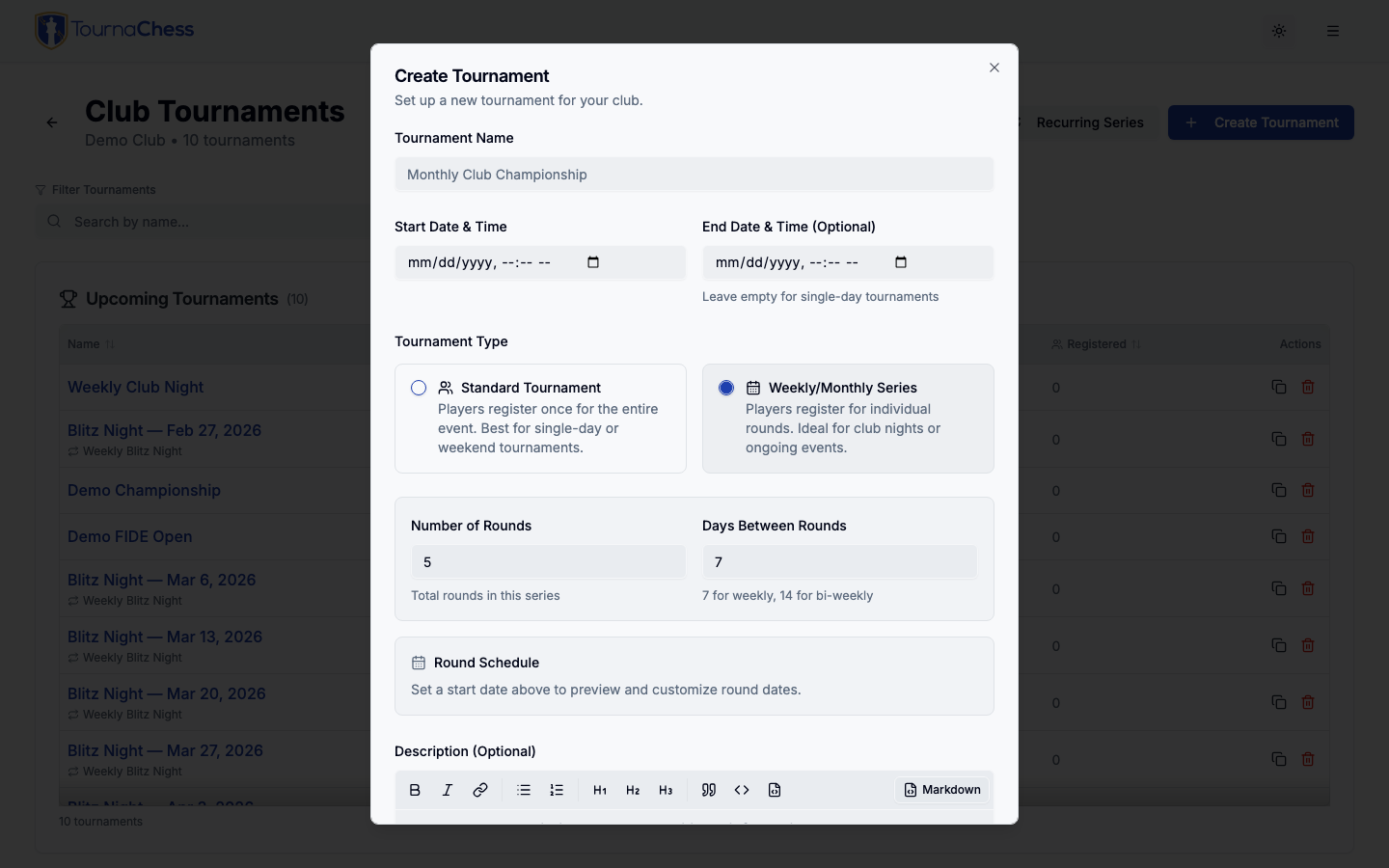
| Set up as | A single tournament in Per Round mode, one round per week | A Recurring Series that generates a new tournament on schedule |
| Standings | One table across the weeks, like a Swiss played one round per night | Each night has its own winner; a Grand Prix totals the season |
| Rating submission | One export at the end, covering every week | One export per event |
| Best for | A "Tuesday Night Swiss" where the eight weekly rounds are one rated event | A club blitz or quick night that stands on its own each week |
The two combine well: a Recurring Series can generate four-week Per Round tournaments, each of which feeds into a season-long Grand Prix.
A worked example: Tuesday Night Swiss
A club runs an eight-week Swiss, one round every Tuesday, one section, USCF rated, with a small entry fee per round. This is how it plays out on TournaChess.
Before week one. A director creates the tournament with Per Round registration, eight rounds, and a scheduled date for each round. The section accepts BYE requests at half a point, with a maximum of two per player, so regulars can plan around a holiday. The public registration link goes in the club newsletter, and the club's calendar feed shows each Tuesday as its own event in members' calendar apps.
Week one. Fourteen players signed up online, choosing the weeks they expect to attend. Two more walk in and are added at the venue with TD Quick-Add, which finds their ratings from the USCF database. The director generates pairings, glances at them, confirms the round, and puts the pairings on the club's TV through the display view. Results go in with one click from a phone as games finish, and the standings update on the TV within seconds.
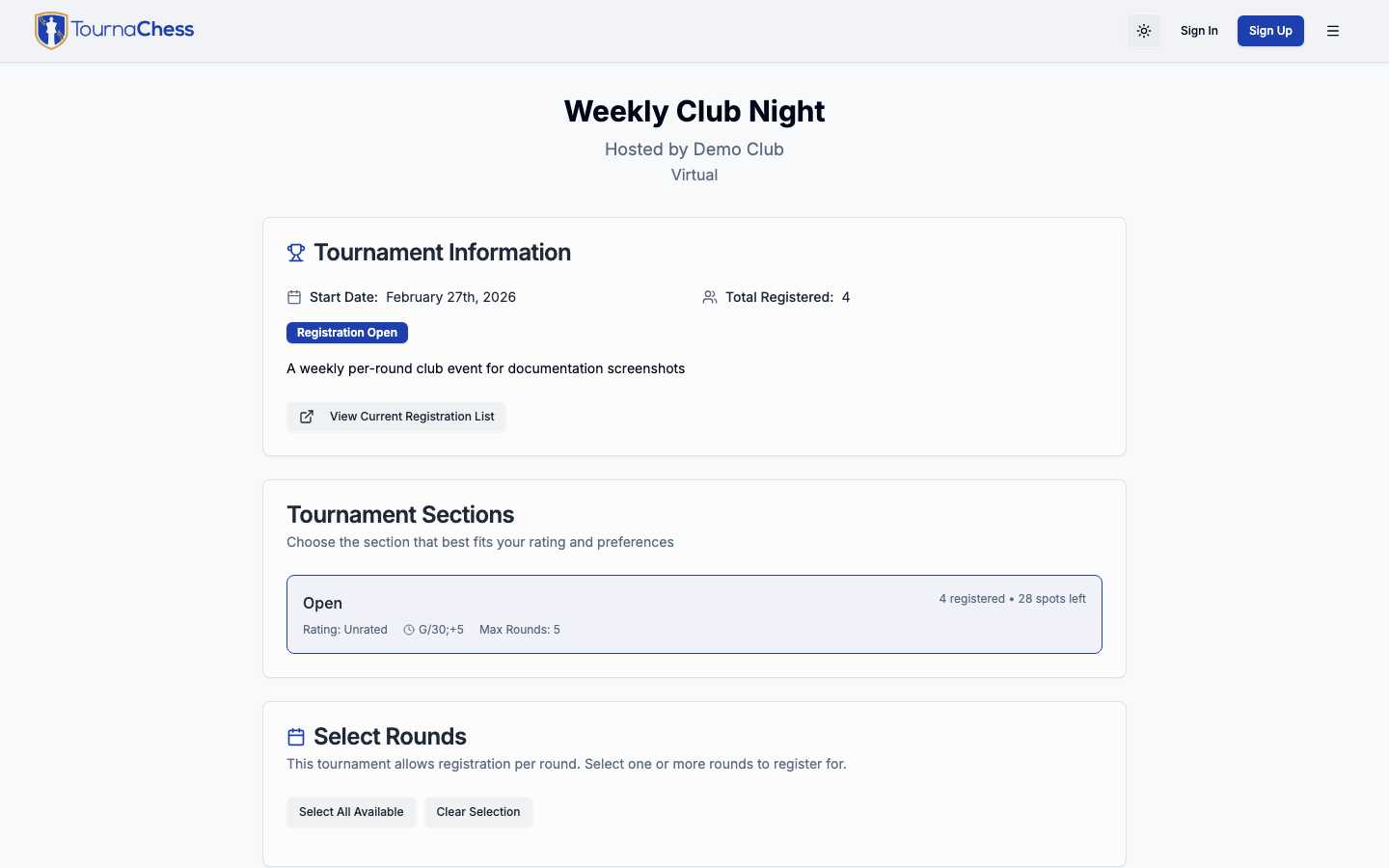
Week three. A new player arrives who has never played at the club. She registers on her phone for round three and, because she was not entered in rounds one and two, the form lets her request a half-point BYE for each of them. Those points count immediately and she is paired on merit from round three. Meanwhile a regular who told the director he could not make week three has a half-point BYE already recorded from his registration, and another regular who simply did not sign up for the week is left unpaired and scores nothing for it.
Week eight. After the final round the director exports the event for USCF rating. Because the club linked the tournament to its "Autumn Grand Prix", every player's final score has already been added to the season standings, along with one participation point for the event. (A Grand Prix counts tournaments, not rounds: a club that wants a point for every Tuesday runs each night as its own tournament, generated by a recurring series.)
How drop-in players join
Per Round mode is designed around attendance that changes from week to week:
- Players pick their weeks. The registration form lists every round with its date. A first-time registrant selects one or more rounds and pays for the ones that carry a fee. Rounds that have already been paired are not offered.
- Returning players are recognized. A player who comes back to add another week is matched by USCF ID, FIDE ID, NWSRS ID, or name, and sees which rounds they already hold.
- You can limit sign-ups to the next round. The Next round only setting in the tournament's registration settings keeps players from booking weeks far in advance, which reduces no-shows. Each round opens for registration as soon as the previous one has been paired, so sign-ups for next week can arrive while this week's games are still being played.
- Walk-ins are added at the venue. TD Quick-Add searches past players at your club and the USCF database, or takes typed-in details. Adding a walk-in for tonight's round takes a few seconds.
- Or the director controls the roster. Set Who Can Register to TD managed and nobody signs themselves up; you add each player to each round.
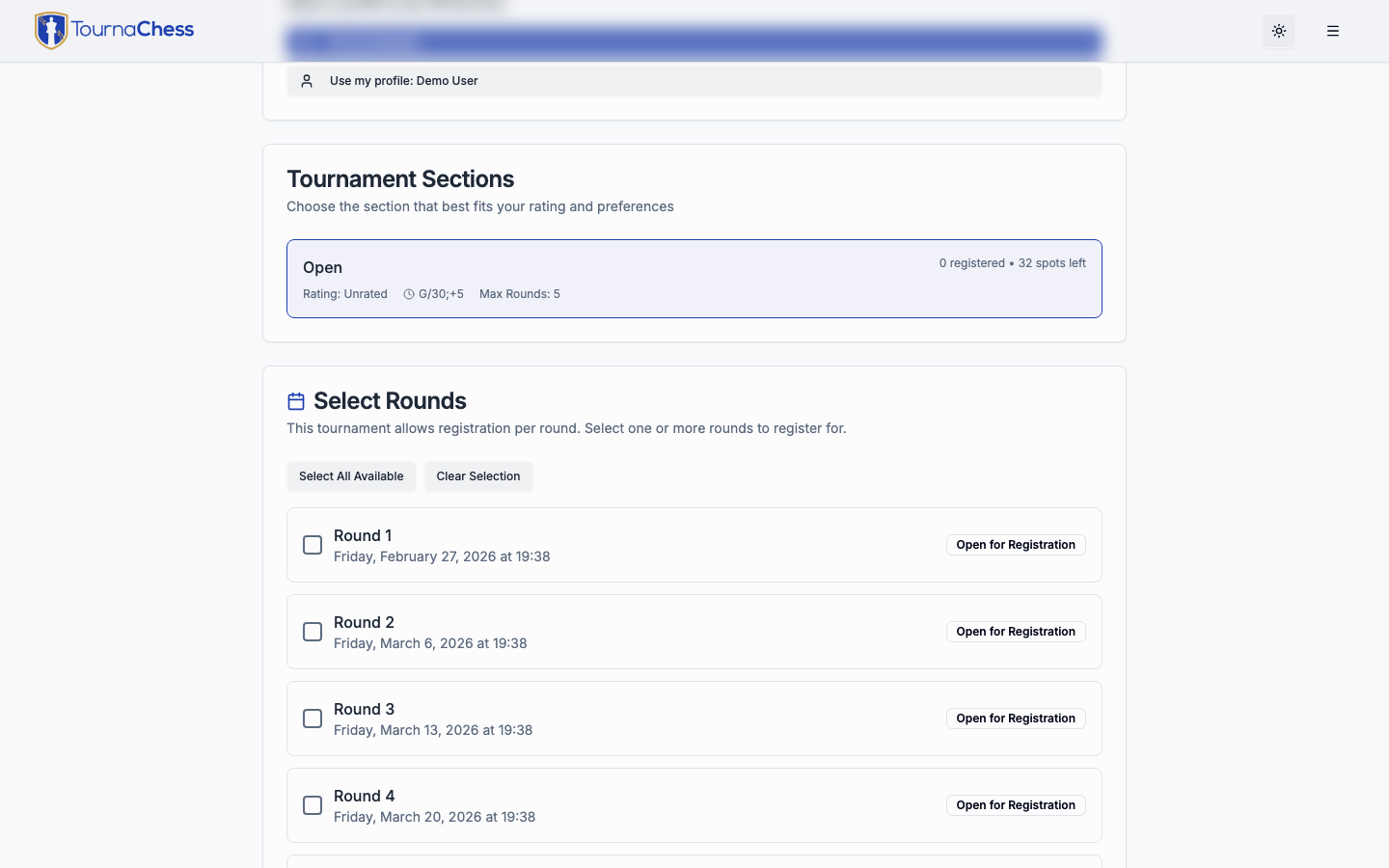
Registration stays open all season, until the final round is paired or a registration deadline you set passes.
Absences, byes, and withdrawals
Weekly events live and die on how gracefully they handle people not showing up.
- Not signed up for a round. The player is unpaired for that round and scores nothing. Nothing needs to be done; they are paired normally in any later round they sign up for.
- Requested BYEs. If the section accepts BYE requests, a player asks for one on the registration form, worth whatever the section pays (half a point by default). You set the maximum number of requests per player and can block BYEs in particular rounds. The rules for which rounds can be requested keep a request from rewriting rounds that have already been played.
- Late joiners. A player who joins in week three can request BYEs for weeks one and two at registration, subject to the section's policy.
- Director overrides. From the registrations table, a director can set any player's status for any round: playing, unpaired, a BYE worth 0, ½, or 1 point, or withdrawn. This is how you grant a half-point to someone who phoned in sick, or fix a request made in error.
- Odd numbers. When a round has an odd number of players, the pairing engine assigns a full-point BYE to one of them following the section's pairing rules.
- No-shows after pairing. If a paired player does not turn up, record a forfeit, or drag them out of the pairings before confirming the round. See Running Tournaments.
- Leaving for good. Mark the player withdrawn. Their past results stand and they are excluded from future rounds. If they come back in a month, reinstate them.
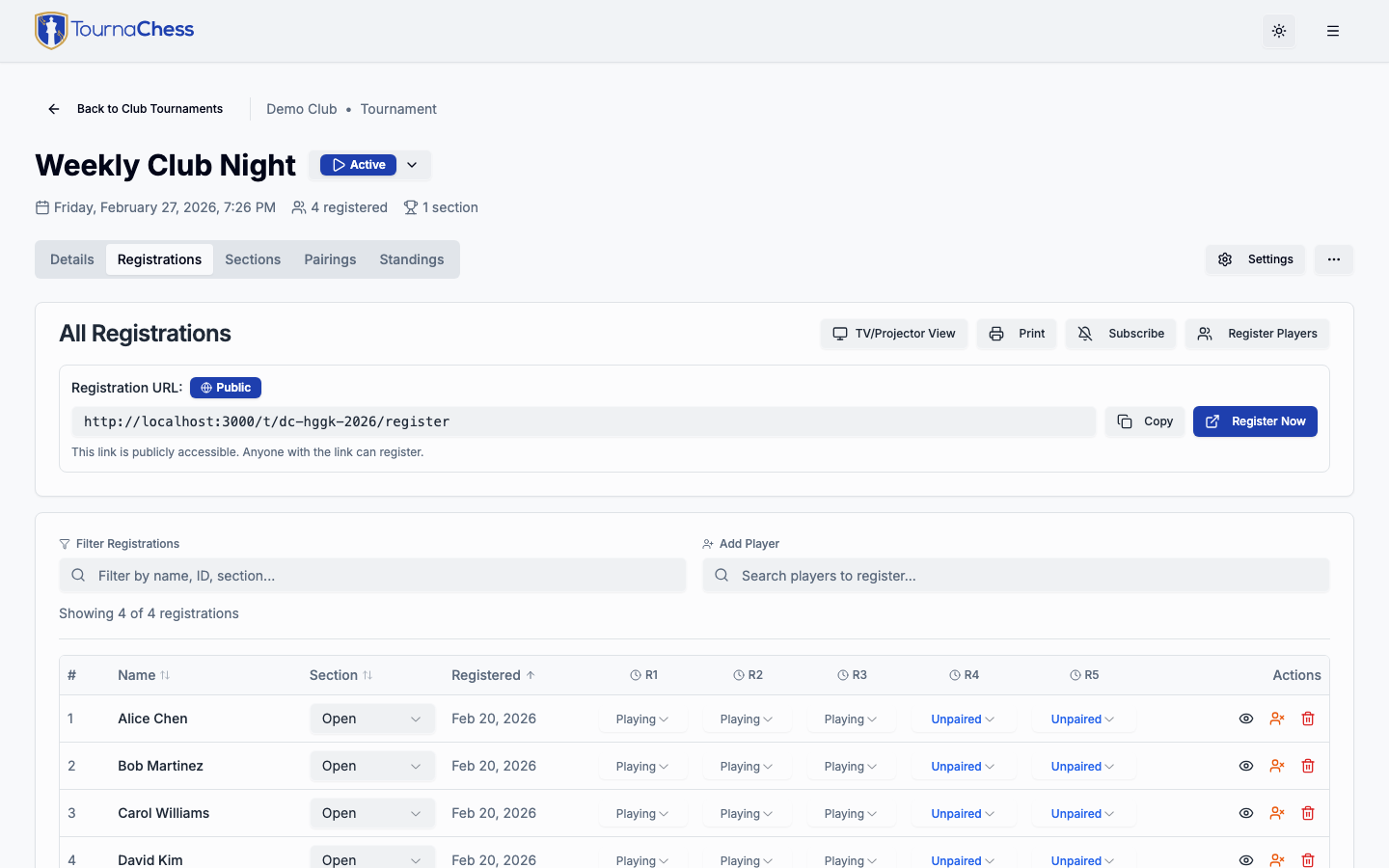
Note: Player check-in is a display-only indicator of who has arrived. It does not decide who gets paired. In a Per Round event, the round sign-up is what puts a player into the pairing; check-in is a way to see at a glance who is still missing.
Recurring events
A Recurring Series takes one tournament as a template and generates copies on a schedule: weekly, every other week, a fixed day of the month, or a custom interval. Each copy inherits the template's sections, time controls, pairing method, BYE settings, entry fees, promo codes, custom fields, registration mode, and Grand Prix link, with dates shifted to the new occurrence. Tournaments are generated several weeks ahead, usually as drafts you publish when ready. You can skip a date, pause over the summer, and push template changes to upcoming occurrences with Sync from Template.
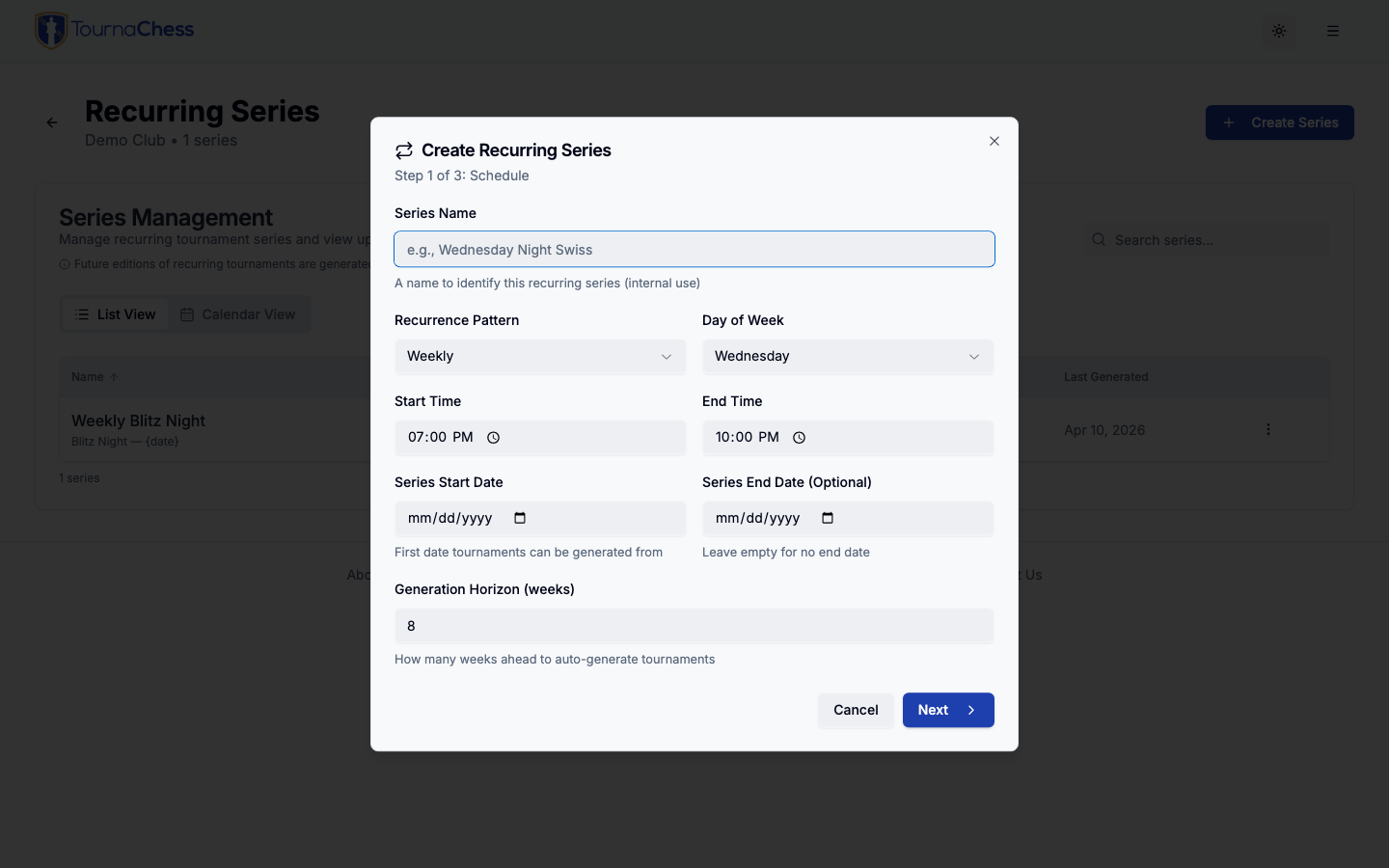
Two things a series does not do:
- It does not carry players over. Each generated tournament has its own registrations, so a player signs up for each week's event. If you want a standing roster across weeks, use one Per Round tournament instead.
- It does not change the template after the fact. The template is fixed when the series is created. To switch templates, end the series and start a new one.
Season standings with Grand Prix
A Grand Prix links any number of tournaments and keeps a running leaderboard. Each player's points are their score in each linked event, plus optional bonuses you configure: one point for every event played, and bonuses for finishing first, second, or third. Directors can also award manual bonus points, for a best-game prize or a club championship, say. Standings can be a single combined table, one table per section, or manually assigned divisions, and ties can be broken by wins and then by events played.
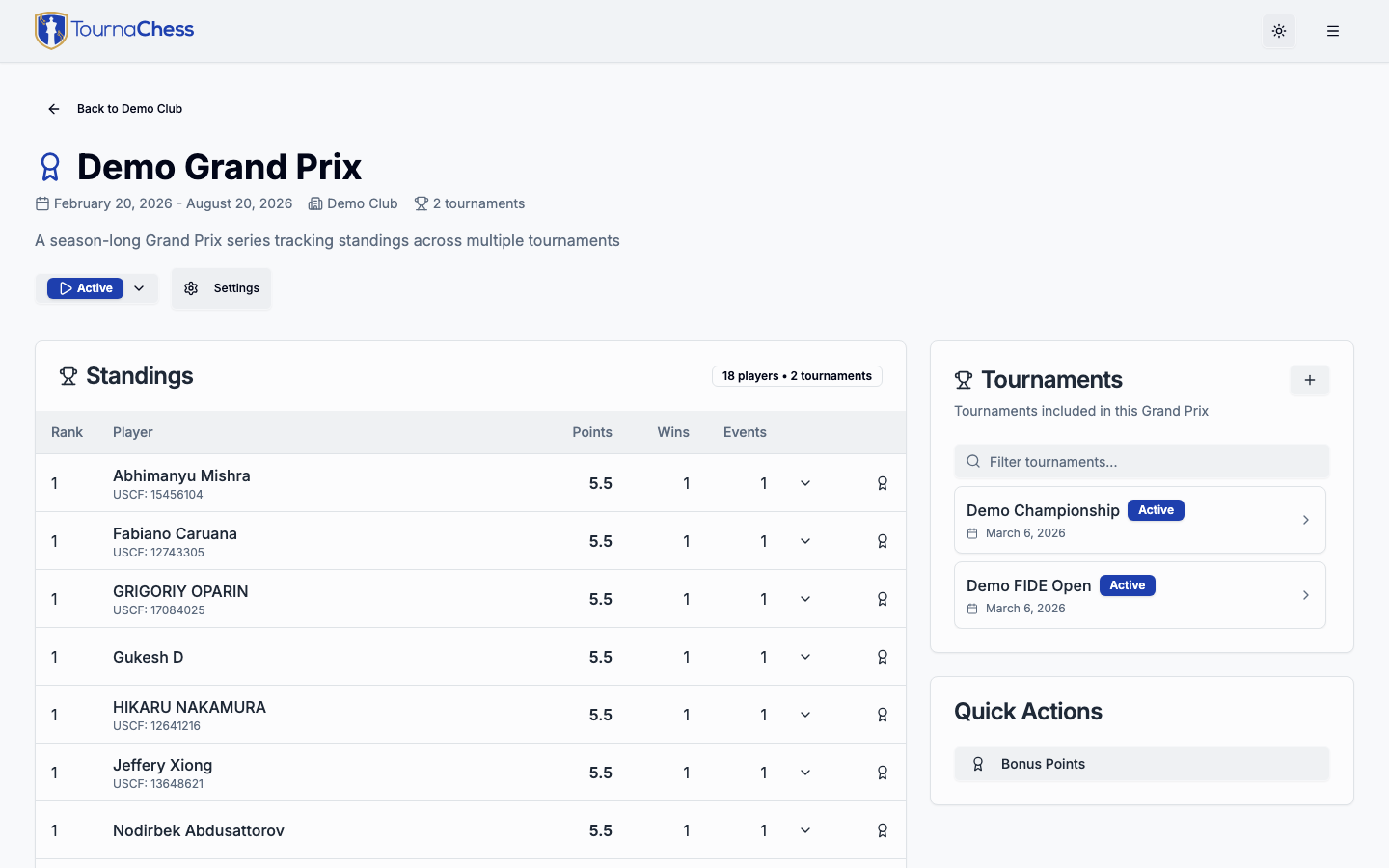
Players are matched across events by USCF ID when they have one and otherwise by name, so a regular who registers as "Jon Smith" one week and "Jonathan Smith" the next appears twice. Ask players to enter their USCF ID, or to spell their name the same way every week.
Two limits worth knowing before you announce the scoring rules:
- Every event counts. There is no "best six of ten" option and no way to drop a player's worst results. If you want the leaderboard to reward turning up, use the participation point.
- Points are raw scores. A five-round event contributes up to five points and a three-round event up to three, with no weighting or multiplier per event. If your events differ in length, place bonuses are the tool for evening them out.
Keeping players informed
- The tournament page works on a phone. Pairings, standings, and the round schedule are public by default, with no account needed to look. A filter box finds a name or board in a large section.
- Pairing notifications. Players who opt in are emailed each round's pairing for free. Text messages use SMS credits the club buys in advance, and can be switched off for casual nights.
- The venue screen. Any device with a browser can show pairings, standings, or the entry list on a TV, with a QR code that opens the tournament page. In a Per Round event the entry list shows only the players signed up for the round about to be paired, so you can spot an odd section before pairing.
- Withdrawing without a phone call. Confirmation emails carry a Withdraw button unless you turn off Allow self-withdrawal for the event, and subscribed directors are told when someone uses it.
What it costs
Pricing is per club, not per director or per player, and every plan allows unlimited tournaments. The Free plan caps each tournament at 16 players across all sections; the Club and Pro plans remove the cap. If you collect entry fees through Stripe, a small platform fee comes off each paid registration on the Free and Club plans; in a Per Round event that fee applies to each round a player pays for. There is no platform fee on free events. Details and current prices are on the pricing page.
Limitations to know before you start
- Registration mode is locked once anyone registers. Choose Per Round or Full Tournament when you create the event. A tournament can only be switched while it is a draft with no registrations.
- Per Round mode cannot be combined with USCF Double Swiss.
- Attendance is marked per player. There is no bulk "everyone on this list is playing tonight" action; a director adds or changes players one at a time, and players add themselves.
- A series copies settings, not people. See Recurring events above.
- Grand Prix has no best-N scoring or event weighting. See Season standings above.
- An internet connection is required at the venue for pairing, result entry, and the display. See Any Device, Nothing to Install for what depends on the connection.
Related guides
- Tournament Types -- Full Tournament versus Per Round mode in detail, including the BYE request rules.
- Recurring Series -- Scheduling options, what is copied, and syncing changes to upcoming events.
- Grand Prix -- Scoring settings, standings modes, and player matching.
- Running Tournaments -- Pairing, results, walk-ins, withdrawals, and printing.
- Player Guide -- What your players see, from registration to notifications.
Still have questions? Visit our Contact page to get in touch with TournaChess support.